GDPR Compliance: What it means for your organization
GDPR compliance is about more than just having a privacy policy, a record of processing activities, and a set of policy documents. An organization is only truly in control when privacy is integrated into daily operations: from new systems and suppliers to HR processes, data breaches, customer inquiries, and the use of new technology.
That sounds logical. In practice, it often proves more difficult.
For example, who monitors whether the record of processing activities is still up to date? When should a DPIA be conducted? How do you know if data processing agreements still align with the actual services provided? And how do you prevent privacy from only receiving attention when an audit, incident, or data subject request comes in?
In this article, we explain what GDPR compliance entails, how to assess where your organization stands, and what is needed to organize privacy in a structural and practical way.
What is GDPR compliance?
GDPR compliance means that an organization meets the obligations set out in the General Data Protection Regulation and can demonstrate that personal data is processed carefully and lawfully.
That last part is particularly important.
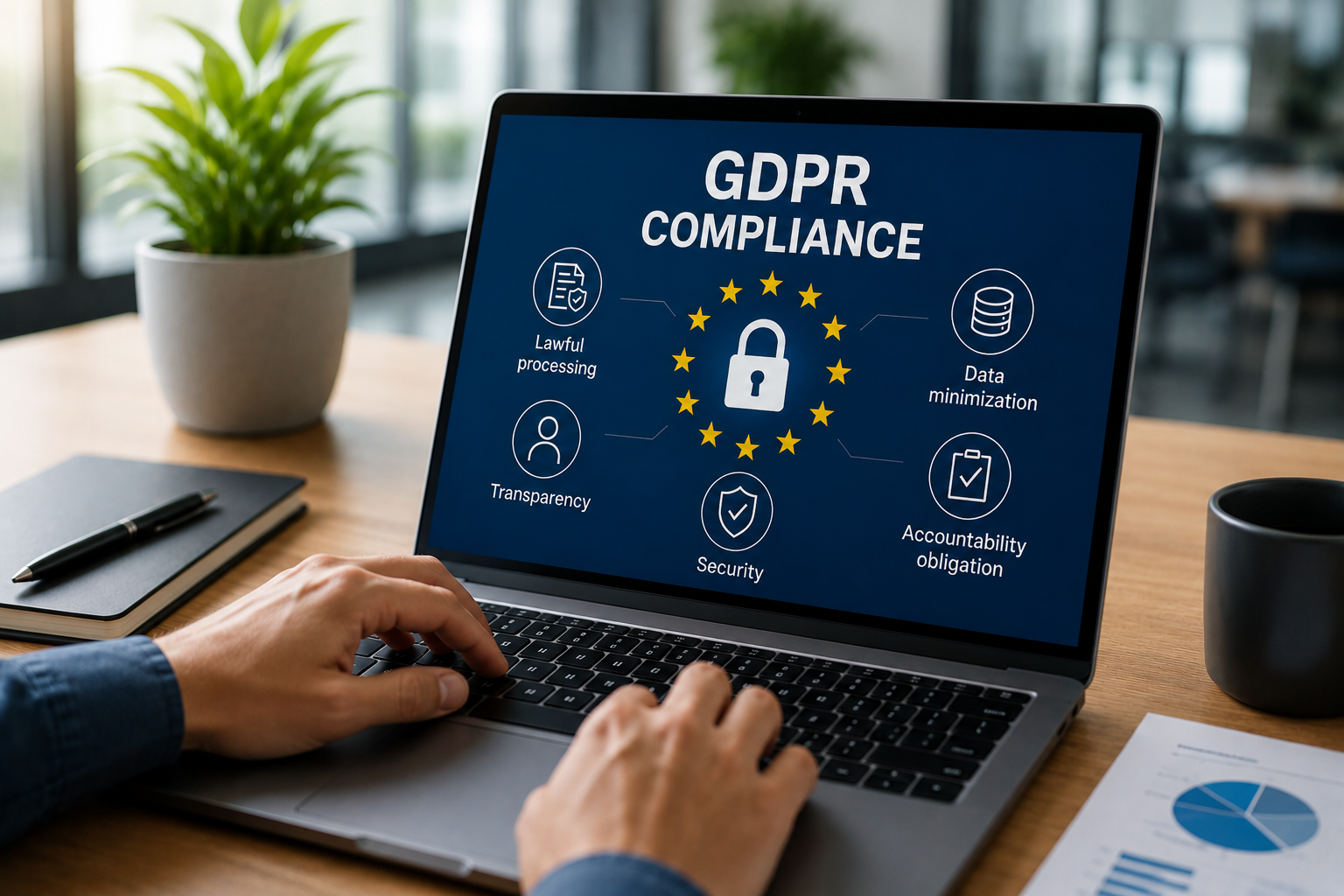
The GDPR includes an accountability principle. Organizations must not only take appropriate measures but also be able to justify why certain choices were made and how privacy risks are managed. The Dutch Data Protection Authority (Autoriteit Persoonsgegevens) cites the record of processing activities, DPIAs, the data breach register, appropriate security, and privacy by design and default as components of this responsibility.
As a result, GDPR compliance is not just about legal documents. It is also about governance, responsibilities, processes, team knowledge, and the way privacy risks are factored into daily decision-making.
An organization can therefore have many things arranged on paper while remaining vulnerable in practice.
When is an organization GDPR compliant?
There is no single certificate or document that allows an organization to definitively state: as of today, we are GDPR compliant.
Organizations change too much for that.
New employees join. Suppliers are replaced. Software is implemented. Marketing activities change. Personal data is used for new purposes. Incidents occur, and new technology brings different privacy risks.
GDPR compliance is therefore not a one-off project, but a continuous process.
A mature privacy organization can, among other things, explain what personal data it processes, on what legal basis, who is responsible for what, which risks have been assessed, which external parties have access to data, and how employees are expected to handle personal data in practice.
In addition, the organization must be able to demonstrate that these agreements are actually being implemented and periodically reviewed.
That gap between policy and execution largely determines how strong your GDPR compliance really is.
GDPR compliance in practice: where does it often go wrong?
GDPR compliance in practice requires translating legislation into concrete operational tasks. This is precisely where organizations often develop blind spots.
A record of processing activities might be neatly organized, for example, while changes from IT, HR, or marketing are not structurally incorporated. A DPIA procedure may exist, yet project teams might not recognize when they need to initiate it. And a data breach procedure offers little security if employees do not know who to report a potential incident to.
A practically designed privacy program therefore brings together several components:
- an up-to-date overview of processing activities, systems, personal data, and involved parties;
- clear roles for the board, management, Privacy Officer, Data Protection Officer, IT, security, and other relevant functions;
- workable procedures for, among other things, DPIAs, data breaches, and data subject requests;
- appropriate agreements and controls regarding suppliers and processors;
- periodic assessment of privacy risks and measures;
- privacy by design in new processes, systems, and projects;
- training and awareness for employees;
- reporting that provides management and the board with insight into risks, progress, and priorities.
The goal is not to create as much privacy documentation as possible. The goal is for the right measures to become part of standard work processes at the right time.
How do you know where your organization stands?
A common challenge is that organizations know they need to do something with the GDPR, but struggle to determine which topics deserve the most attention at this moment.
That is why improvement usually starts with insight.
A GDPR assessment or privacy maturity assessment systematically maps out the current situation. This involves looking not only at available documents but also at processes, responsibilities, and how employees apply these in practice.
This creates a picture of what is already well-organized, where risks exist, and which improvements should be prioritized.
This prevents trying to tackle all privacy topics at once. After all, an organization with a mature record of processing activities but insufficient supplier control has different priorities than an organization where roles, processes, and basic documentation are still largely missing.
A good assessment therefore results not only in findings but, more importantly, in a concrete privacy roadmap: what needs to happen, why, by whom, and in what order?
Which GDPR compliance components deserve structural attention?
The exact setup varies by organization. Size, sector, types of personal data, technology used, and internal capacity determine which measures are appropriate.
Yet, we consistently see the same fundamental question: can the organization demonstrate that privacy risks are being consciously managed?
This requires, for example, an up-to-date register of processing activities, but also ownership of it. It requires a DPIA process, but also employees who know when a DPIA might be necessary. It requires contractual agreements with suppliers, but also oversight of what suppliers are actually doing with personal data.
This shifts GDPR compliance from documentation to governance.
And that is precisely where sustainable control is established.
GDPR compliance in a municipality requires extra attention to practical application
Also GDPR compliance in a municipality goes beyond just ticking boxes on a checklist.
Municipalities process personal data on a large scale across diverse domains and deal with many different processes, systems, partners, and statutory duties. Moreover, personal data can be sensitive and relate to residents who depend on the municipality for services.
At the same time, responsibilities are spread across various departments and policy areas. As a result, a central privacy function alone is not enough. Privacy must also be embedded among process owners, project teams, procurement, IT, information management, security, and management.
For municipalities, coherence is therefore of primary importance.
Who flags a new processing activity? Who determines if a DPIA is needed? How is privacy integrated into procurement? How are the register of processing activities and agreements kept up to date? And how are recommendations from the DPO translated into concrete improvement actions?
An effective approach combines independent oversight with sufficient implementation capacity. The Data Protection Officer monitors and advises, while roles such as Privacy Officers and other responsible functions help to actually implement measures.
In this way, GDPR compliance within a municipality becomes not the responsibility of a single privacy professional, but part of the organization as a whole.
What is the difference between being compliant and being demonstrably in control?
An organization can have many GDPR measures in place without actually having a clear overview.
Demonstrably in control means that you can not only show which measures exist, but also why they are appropriate, who is responsible, and how you verify that they continue to work.
That is a fundamental difference.
When the board or management asks what the most significant privacy risks are at any given moment, you should be able to provide a well-founded answer. The same applies when a client, auditor, regulator, or partner asks how personal data is being protected.
This requires up-to-date information, clear responsibilities, and periodic monitoring.
Compliance thus becomes a manageable process rather than a collection of disconnected privacy activities.
Maintaining GDPR compliance: why an annual check is not enough
A periodic audit or assessment is valuable, but it cannot replace structural privacy governance.
A lot often changes between two assessments. A new SaaS solution might be implemented, a supplier might add sub-processors, a department might start using data for a different purpose, or an AI application might raise new privacy concerns.
Those who only check periodically run the risk of discovering that processes have changed only after the fact.
A mature approach therefore combines periodic assessments with continuous monitoring and clear responsibilities within the organization.
In this way, privacy becomes an integral part of change management, procurement, product development, HR, IT, and other relevant business processes.
When do you need external GDPR consultancy?
Not every organization requires the same amount of privacy capacity at all times. This makes the choice between internal expertise and external support important.
External GDPR consultancy can add particular value when knowledge or capacity is lacking, when backlogs need to be cleared, when independent insight is required, or when complex privacy issues demand specialist expertise.
Sometimes a one-off GDPR Assessment is sufficient to determine your direction. In other situations, structural support is needed for the implementation and further development of privacy governance.
It may also be desirable or mandatory to appoint an independent Data Protection Officer (DPO). In this context, it is important to distinguish between oversight and execution: a DPO advises and provides independent supervision, while operational privacy tasks are carried out by, for example, a Privacy Officer or other responsible parties.
The best setup is therefore not automatically the most extensive one. It is about a model that fits the risks, maturity, and available capacity of your organization.
From GDPR checklist to a practical privacy roadmap
If you want to improve GDPR compliance, you don't have to solve everything at once.
Start by asking where the biggest gaps are between the requirements, established policies, and daily practice. Make those gaps concrete, prioritize them based on risk, and translate them into actionable steps.
Then the most important part begins: implementation.
DPO Consultancy supports organizations from strategy to implementation. Our consultants translate privacy legislation into concrete measures that align with the processes, teams, and responsibilities within your organization.
This can start with an independent GDPR Assessment and subsequently consist of targeted implementation guidance, Privacy Officer support, DPO-as-a-Service, training, or structural Privacy-as-a-Service.
This creates not a standard approach, but a privacy program tailored to your organization.