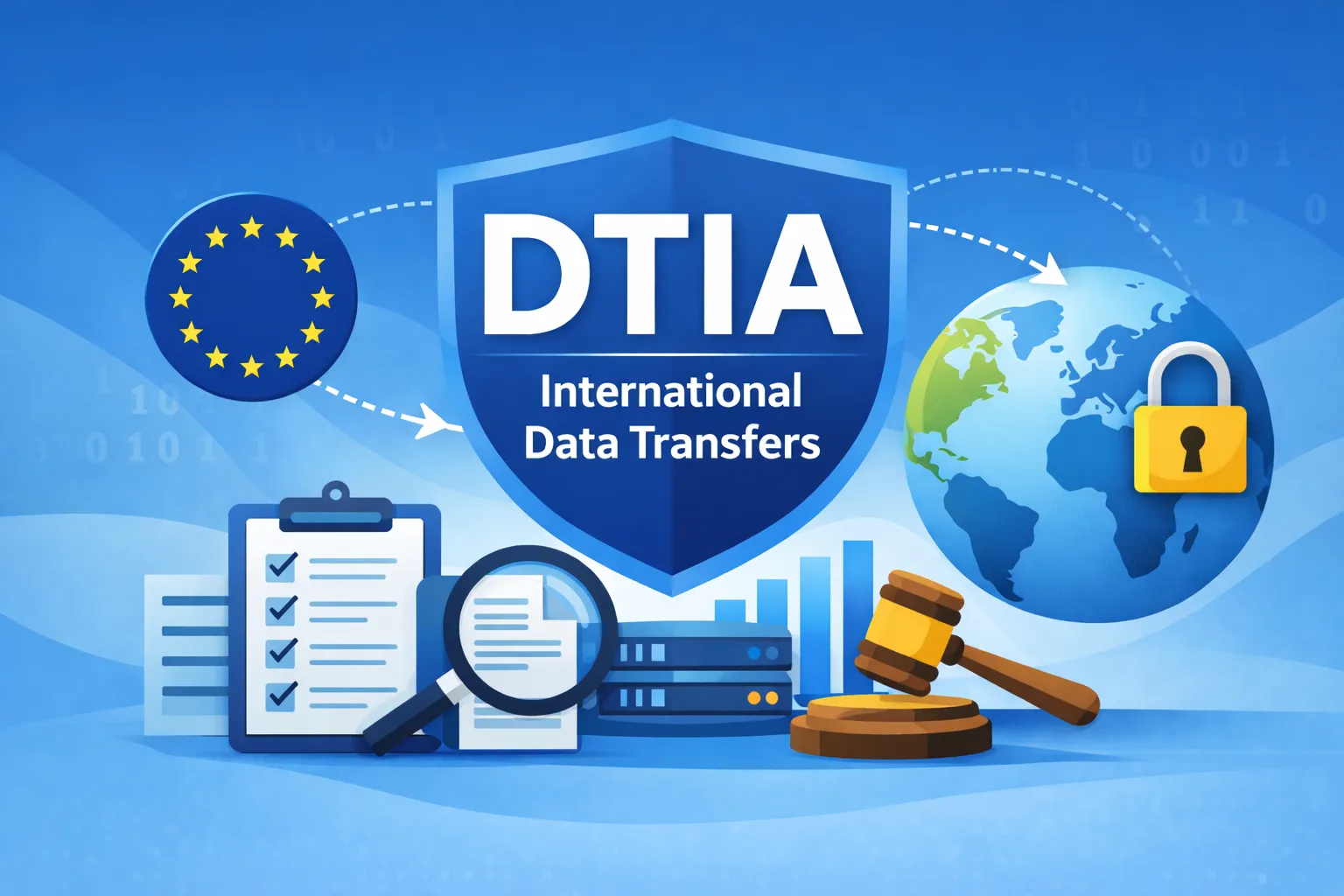
DTIA: control over international data transfers and data sovereignty
International data transfers pose significant risks for organizations. Consider access by foreign authorities, insufficient protection of personal data, and loss of control over data. A Data Transfer Impact Assessment (DTIA) provides insight into these risks and ensures you meet GDPR requirements.
A DTIA is not just a compliance obligation, but an essential tool for governance and data sovereignty. It helps organizations make informed choices when using international suppliers and cloud solutions.
What is a DTIA?
A Data Transfer Impact Assessment (DTIA) is the documentation used to determine whether an international transfer (outside the EEA), for example based on SCCs, provides an adequate level of protection in your specific context and which supplementary measures are required.
Why does this relate to data sovereignty?
Because a DTIA looks beyond just paperwork (contracts) and focuses on actual risks: jurisdiction, (potential) access by (foreign) authorities, supply chain dependencies, and the effectiveness of measures.
You also asked about the relationship with a DPIA in your questionnaire; the only connection is that, like a DPIA, it is a tool for identifying, assessing, and mitigating privacy risks.
European Data Protection Board (EDPB): when exactly is something a "transfer"?
The GDPR does not explicitly define "transfer"; therefore, the EDPB applies three cumulative criteria. A data flow is an international transfer if:
- An exporter (controller or processor) is subject to the GDPR for that processing (Art. 3).
- That exporter makes personal data available (by transmission or "otherwise") to another organization (another controller/processor = importer).
- That importer is located in a third country (outside the EEA) or is an international organization.
International data transfers: when are you truly at risk under the GDPR?
Do you work with cloud software, support teams outside Europe, or suppliers with sub-processors in the US, India, or the UK? If so, there is a high probability that you are dealing with an international data transfer under the GDPR, which requires additional safeguards.
An international transfer occurs as soon as personal data becomes available to a party outside the EEA (the EU + Iceland, Norway, and Liechtenstein) or an international organization. This happens more often than you think: not just when "moving data," but also through remote access, management, support, or hosting.
In short: as soon as a party outside the EEA can access personal data, you must demonstrate that the level of protection remains adequate.
International data transfers (GDPR Chapter V): why a DTIA?
As soon as personal data becomes accessible outside the EEA (e.g., via cloud, remote support, or sub-processors), you fall under Chapter V of the GDPR. You must then be able to demonstrate that the EU level of protection is maintained—even when data crosses borders.
Is there no adequacy decision for the country? Then you often work with SCCs (or BCRs). However, contracts alone are not enough. You must also assess whether they work in practice. That is where a DTIA (Data Transfer Impact Assessment) comes in.
What does a DTIA do?
A DTIA shows:
- Where the transfer takes place and who has access
- What the risks are (including legislation/access by authorities)
- Which measures are necessary (such as encryption, key management, access control, logging)
- Why your transfer is defensible during audits and client inquiries
What are the benefits?
With a DTIA, you have proof that you have implemented Chapter V seriously and that your SCCs are supplemented with appropriate technical and organizational measures.
When is a DTIA advisable?
A Data Transfer Impact Assessment (DTIA) helps you gain control over risks associated with international data transfers before they become a problem.
Do you work with parties outside the EU, or are your systems (partially) accessible from third countries? Then it is wise to consider the risks to personal data. For example:
- Use of US cloud providers
- Collaboration with international SaaS vendors
- Outsourcing of IT or HR services to third countries
- Remote access from non-EU countries
In these situations, conducting a DTIA is not an administrative burden, but an opportunity: you map out risks concretely and demonstrate that you are demonstrably in control.
Even when working with Standard Contractual Clauses (SCCs), a DTIA is an important step. Since the Schrems II ruling, the focus has shifted from just paper agreements to the question: are the data truly well-protected in practice?
By proactively conducting a DTIA, you avoid surprises later on, strengthen your compliance position, and build trust with customers and regulators.
In short:
As soon as personal data leaves the EU, you must assess whether this is done safely and lawfully.
How do you conduct a DTIA? (Process overview)
A DTIA follows a structured approach that provides insight into data flows, risks, and necessary measures.
Step 1: Mapping the processing
Collect all relevant information about the data processing, such as the type of personal data, the purpose of the processing, and the parties involved.
Step 2: Identifying onward transfers
Check whether data is being transferred to other parties (sub-processors) and to which countries these transfers are taking place.
Step 3: Analysis of the third country
Assess the laws and regulations of the receiving country, particularly regarding the extent of government access and the protection of personal data.
Step 4: Risk assessment
Weigh the identified risks and determine whether the level of protection is equivalent to that within the EU.
Use our DTIA tool for structured execution
Common mistakes in DTIAs
Many organizations perform DTIAs incompletely or incorrectly, leading to compliance risks.
Where things often go wrong:
- Signing SCCs only, without a substantive analysis
- Failing to assess legislation in the third country
- Failing to implement supplementary measures
- Failing to conduct periodic reassessments
- Insufficient or missing documentation
A DTIA is not a checklist, but a substantive risk analysis that must be demonstrable.
Our solutions
We support organizations in performing fully compliant DTIAs; from analysis to documentation.
DTIA-as-a-Service & Atlas
- Full execution by privacy experts
- Analysis of third-country legislation
- Comprehensive risk assessment
- Advice on supplementary measures
- Complete documentation for regulators
With our tooling and expertise, you gain quick insight and certainty regarding international data transfers.
Read more about our DTIA-as-a-service & Atlas proposition
FAQ
Who can help with conducting a transfer impact assessment?
Privacy consulting firms with expertise in international data transfers can support organizations in assessing transfers to countries outside the European Economic Area. DPO Consultancy assists organizations with Transfer Impact Assessments and other assessments regarding international data flows. This includes evaluating data flows, receiving parties, transfer mechanisms used, relevant legislation, and necessary supplementary safeguards. The goal is to ensure international transfers are demonstrably compliant and well-managed.
We are going to share personal data with a partner outside the EU and I don't know what we need to arrange for this. Where do I start?
Start by determining which personal data is being transferred, to which party, in which country, and for what purpose. Next, check which transfer mechanism is available, such as an adequacy decision or appropriate safeguards like Standard Contractual Clauses. Depending on the situation, a Transfer Impact Assessment may also be required. In this assessment, you evaluate whether personal data is actually sufficiently protected in the receiving country and whether supplementary measures are necessary.
What exactly is a Transfer Impact Assessment and when do you need one?
A Transfer Impact Assessment (TIA) is an assessment of the risks associated with an international transfer of personal data. It examines, among other things, whether the legislation and practices in the receiving country could affect the protection of the data. A TIA is particularly relevant when personal data is transferred outside the EEA based on certain appropriate safeguards, such as Standard Contractual Clauses. The assessment helps determine whether additional technical, organizational, or contractual measures are required.